

FAQ Sections on Shopify: Quiet Objection Handling That Also Ranks

Most FAQ sections are an afterthought. Someone adds five generic questions near the footer, writes "How long does shipping take?" and "What is your return policy?", and never touches it again. That version of an FAQ does nothing except take up space.
The useful version is different. A good FAQ section is the place where you answer the specific things that stop people from buying, in the exact spot where the doubt shows up. It is the cheapest conversion work available to a store owner, because you are not designing anything new. You are writing down what you already know about your customers.
The real job of an FAQ
Every product has a short list of reasons people hesitate. Will this fit. Is it worth the price compared to the cheaper one. How do I know it will work for my skin, my dog, my bike, my apartment. What happens if it does not.
Those questions get asked in your inbox, in your DMs, in your support tickets, and in the heads of the shoppers who never contacted you and simply left. An FAQ section is where you answer them before they turn into an exit.
That reframes the whole exercise. You are not writing an FAQ. You are writing down your top objections and answering them honestly, in public, where the hesitation happens.
Where the questions actually come from
Do not invent your FAQ. Harvest it.
Open your support inbox and read the last fifty messages. Note what people asked before they bought, not after. Those pre purchase questions are your list, ranked by how often they appear.
Read your product reviews, especially the three star ones. They tell you what surprised people, and surprises are just unanswered questions that arrived too late.
Check your on site search terms in Shopify analytics. If people are searching "sizing" or "ingredients" or "shipping to Canada", they could not find that information where they expected it.
Ask your customers directly. A one line question in a post purchase email, "what almost stopped you from ordering", produces better copy than any brainstorm.
Write answers, not deflections
The difference between an FAQ that works and one that annoys people is honesty.
"What is your return policy?" answered with "please see our returns page" is a dead end. Answer it: "Thirty days, unworn, we pay return shipping in the US. Outside the US you cover the return label."
Answer the hard ones too. If your product is not right for everyone, say so. "Will this work on curly hair?" answered with "yes, it works for all hair types" is the answer nobody believes. "It works best on loose curls. If your hair is tightly coiled, the heavier balm in our range is the better fit" builds more trust and sells the right product to the right person.
Keep each answer to a few sentences. If an answer needs five hundred words, it deserves its own page, and the FAQ entry should be a short summary with a link.
Why accordions are the right format
An FAQ needs to be scannable, because nobody reads all of it. A shopper is looking for their one question.
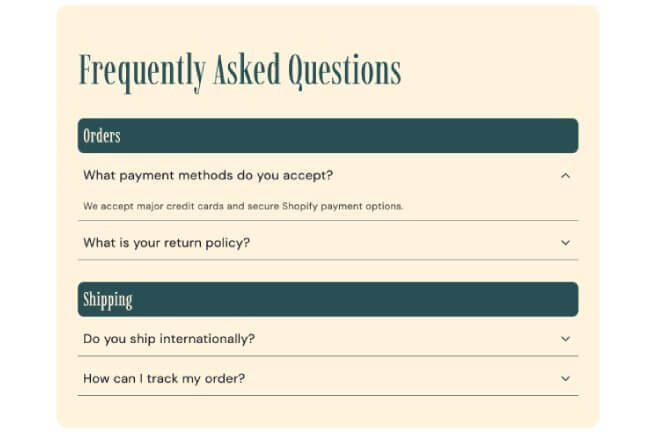
An accordion section solves that. Every question is visible as a heading, the answers stay collapsed, and the shopper opens only the one they care about. Ten questions take up the space of ten lines instead of two screens of scrolling. That matters even more on mobile, where a long open FAQ can push everything below it into oblivion.
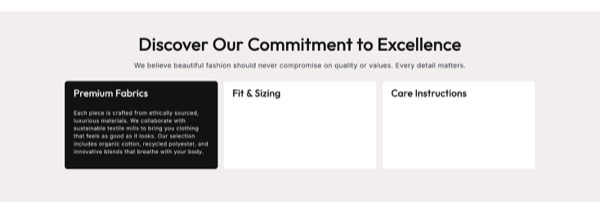
The same pattern works beyond support questions. A features accordion uses the collapsed format to explain what a product does without burying the buy button, and info tabs split details, materials, care, and shipping into a compact set the shopper can flip through. Same idea, different content.
One caution. Anything hidden behind a click gets read less. Put your single most important answer as visible copy in the product description, and use the accordion for the rest.
Placement changes the result
An FAQ in the footer is a reference document. An FAQ where the doubt lives is a conversion tool.

On a product page, put the FAQ below the description and above the reviews, close enough to the buy button that a hesitating shopper finds it without a hunt. The questions there should be product specific: sizing, materials, compatibility, how to use it.
On a collection or category page, an FAQ can answer the "which one do I pick" question that keeps people bouncing between products.
On a dedicated support page, keep the broad operational questions: shipping timelines, order changes, wholesale, contact.
You can run different questions in each place. A store wide FAQ pasted onto every product page is a wasted opportunity, because the objection on a hundred dollar jacket is not the objection on a ten dollar candle.
The SEO side, without the myths
There is a persistent belief that adding an FAQ section produces those expandable question results in Google. That used to be true. It is not anymore. Google first narrowed FAQ rich results to a small set of authoritative sites, then deprecated the feature outright on 7 May 2026. Nobody gets the expanded snippet now, no matter how clean the markup.
That does not make FAQ content worthless for search. It makes it worth doing for the ordinary reason: it is real, unique, useful text on a page that probably does not have much of it. Section and product pages tend to be thin, and a genuine set of questions and answers adds the specific, long tail language people actually type. Someone searching "does the alpine jacket fit true to size" is a shopper with a wallet out, and your FAQ answer may be the only page on the internet that addresses it.
You can leave FAQPage structured data in place. Google has said unused structured data does not cause problems and the schema type is still valid, so there is no urgency to strip it out. Just do not add it expecting a visual result, and do not build a traffic plan on it.
One rule: never write questions nobody asks purely to stuff keywords. It reads as spam to shoppers and adds nothing for search.
Where FAQs pay off now: AI Overviews and AI answers
The rich result went away, but a different surface opened, and an FAQ is unusually well suited to it.
Start with what Google actually says, because there is a lot of noise here. Google's own documentation is blunt: there are no additional requirements to appear in AI Overviews or AI Mode, and no special optimizations. You do not need a new machine readable file, an AI text file, or extra markup. A page needs to be indexed and eligible to show a snippet in normal search. That is the whole technical bar. Anyone selling you a special AI schema is selling you something Google says does not exist.
What does matter is shape, and this is where an FAQ has a quiet advantage. AI answers are assembled from passages, not whole pages. A page that answers one specific question completely, in three sentences, under a heading that states the question, is easy to lift. A page where the same answer is scattered across five hundred words of preamble is not.
An FAQ is that shape by default. Question as the heading, self contained answer underneath, no dependency on the paragraph before it. Write each answer so it still makes sense pulled out of the page on its own, because that is exactly what happens.
The second advantage is phrasing. People type longer, more conversational questions into an assistant than into a search box. "Does the alpine jacket run small" is not a keyword, it is a sentence, and it is the exact shape of an FAQ entry. Harvesting real customer questions gets you that language for free, which is another reason not to invent your list.
Two honest caveats. First, a citation is not a click. An AI answer often resolves the question on the spot, so treat the appearance as brand presence rather than traffic, and judge it accordingly. Second, that makes the content of the answer matter more, not less. A generic answer gets absorbed and forgotten. An answer with a real opinion in it, the "it works best on loose curls, if your hair is tightly coiled the heavier balm is the better fit" kind, is the one that makes someone come to the store to see what else you know.
If there is a passage you do not want used this way, the ordinary controls still apply: nosnippet, data-nosnippet on a specific block, max-snippet, and noindex. There is no separate AI opt out to hunt for.
Keep it alive
An FAQ is not a launch task, it is a maintenance habit. Every time the same question hits your inbox twice in a week, it belongs in the FAQ. Every time you change a policy, the FAQ changes with it. A stale FAQ that promises two day shipping you no longer offer does more damage than no FAQ at all.
Set a reminder to review it quarterly. It takes twenty minutes and it is usually the highest value twenty minutes in the quarter.
The bottom line
An FAQ section works when it stops being a formality and starts being an honest answer to the things that keep people from buying. Harvest the questions from real customers, answer them plainly, put them where the hesitation happens, and keep them current.
If you want the format handled for you, the Abra accordion section installs straight into your theme and stays on brand, and the full section library has tabbed and feature variations for when a plain question list is not the right shape.
Frequently asked questions
How many questions should an FAQ section have? Five to ten on a product page, more on a dedicated support page. Rank them by how often they come up before purchase and cut anything you added just to fill space. A short list of real questions beats a long list of invented ones.
Should the FAQ go on the product page or a separate page? Both, with different content. Product specific doubts like sizing, materials and compatibility belong on the product page near the buy button. Broad operational questions about shipping, returns and contact belong on a support page.
How do I get my FAQ answers into AI Overviews? There is no special markup or file for it. Google's documentation states there are no additional requirements or optimizations for AI Overviews and AI Mode beyond being indexed and eligible for a normal snippet. What helps is structure: state the question as the heading and write an answer that still makes sense lifted out of the page on its own.
Does an FAQ section still help SEO? Yes, but not through rich results. Google dropped FAQ rich results entirely in May 2026, so no store gets the expanded listing anymore. The value now is plainer: an FAQ adds unique, specific text to pages that are otherwise thin, and it matches the long tail phrasing shoppers actually type.